Table of Contents
Gold Price Today By Insrivo Team | December 11, 2025
In the ever-shifting landscape of global finance, few assets command the timeless allure and resilience of gold. As we close out a year marked by unprecedented volatility, the gold price today stands as a beacon of stability for investors navigating the storms of economic uncertainty. On December 11, 2025, the current gold price is trading at approximately $4,221 per ounce, holding firm above the psychologically significant $4,200 mark after a slight 0.36% dip from yesterday’s close of $4,236.20. This consolidation follows the U.S. Federal Reserve’s third consecutive rate cut, underscoring gold’s role as a safe-haven asset in times of monetary policy flux and geopolitical tension.
At Insrivo, your trusted digital lending platform for insurance and finance insights, we understand that rising gold prices aren’t just numbers on a chart—they signal broader economic ripples that affect everything from retirement portfolios to insurance premiums and lending rates. With gold prices rising over 60% year-to-date in 2025, driven by inflation pressures, a weakening U.S. dollar, and surging central bank demand, investors are turning to this precious metal as a hedge against the unknown. In this comprehensive guide, we’ll dive deep into the gold price today, unpack the key drivers behind the surge, explore forecasts for 2026 and beyond, and offer practical advice on how to integrate gold into your financial strategy. Whether you’re a seasoned investor or just starting to diversify your assets, this 2025 analysis will equip you with the knowledge to make informed decisions.
For more on how economic uncertainty impacts your lending and insurance needs, check out our latest insights on personal finance trends. And if you’re considering gold as part of your portfolio, explore our investment insurance options to protect your gains.
Current Gold Price Snapshot: What $4,221 Means for Investors
Let’s start with the facts on the live gold price. As of this morning, the spot gold price hovers around $4,221.10 per troy ounce, reflecting a modest decline within today’s range of $4,215.30–$4,247.90. For context, that’s a staggering leap from the $2,500 levels at the start of 2025, representing a 68% gain and marking gold’s strongest annual performance since the late 1970s.
But what does the current gold price mean in practical terms? For everyday investors, it translates to:
- Physical Gold: A one-ounce American Eagle coin now costs around $4,300–$4,400, including premiums for minting and dealer margins.
- Gold ETFs: Popular funds like SPDR Gold Shares (GLD) are trading at levels that mirror the spot price of gold, offering easy exposure without storage hassles.
- Jewelry and Bars: Retail prices in markets like India (Rs 1,30,320 per 10 grams) and China have surged, curbing discretionary demand but boosting investment buying.
At Insrivo, we’ve seen how these fluctuations impact personal finance. With inflation lingering above the Fed’s 2% target and consumer spending slowing, gold’s stability is a welcome counterbalance to volatile stocks and bonds. Yet, as our Market News & Analysis section highlights, this isn’t a bubble—it’s a response to structural shifts we’ll explore next. For a visual breakdown, see the historical gold price chart below, showing the gold price trend over the past year.
| Metric | Value (Dec 11, 2025) | Change from Yesterday | YTD Gain |
|---|---|---|---|
| Spot Gold Price per Ounce | $4,221.10 | -0.36% | +68% |
| Gold Price per Gram | $135.80 | -0.36% | +68% |
| Gold Futures (Feb 2026) | $4,271.30 | +1.1% | N/A |
Data sourced from COMEX and LBMA benchmarks.
The Perfect Storm: Why Gold Prices Are Rising in 2025
Gold’s meteoric rise in 2025 isn’t random; it’s the culmination of interconnected macroeconomic, geopolitical, and policy forces. Economists and analysts from the World Gold Council to J.P. Morgan point to a “perfect storm” of uncertainty that’s propelled the metal to record highs. Let’s break down the primary drivers behind why gold prices are rising—focusing on high-search-volume factors like economic uncertainty, inflation, and safe-haven demand.
1. Heightened Economic Uncertainty and Recession Fears
At the heart of the rally is a palpable fear of economic slowdown. The U.S. economy is grappling with mixed signals: job openings rose to 7.67 million in October, but payroll data hints at softening labor markets, fueling recession whispers. Globally, GDP growth is projected to stagnate below trend levels in the second half of 2025, exacerbated by trade tariffs and supply chain disruptions.
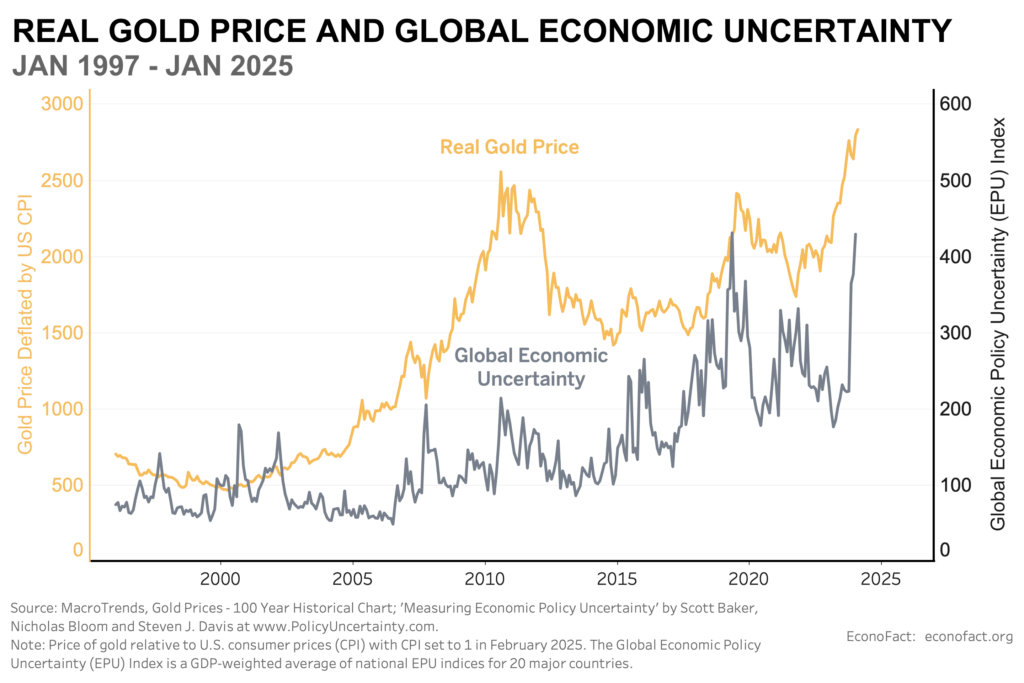
This economic uncertainty—measured by rising policy disagreements, expiring tax provisions, and forecast divergences—has spiked to levels unseen since the COVID-19 peak, directly correlating with a 40%+ gold surge since late 2024. As one World Bank report notes, “When uncertainty rises, gold rallies,” with precious metals up 42% in 2025 alone due to safe-haven demand.
For Insrivo readers, this translates to real-world implications: higher insurance premiums amid climate-related risks and volatile retirement savings. Gold acts as a portfolio ballast, preserving wealth when equities falter. Learn more in our guide to hedging economic risks.
2. Persistent Inflation Pressures and Fed Policy Shifts
Inflation remains the elephant in the room. Despite the Fed’s aggressive rate cuts—bringing the benchmark to 3.50%–3.75%—U.S. CPI is expected to hover at 2.9% by year-end, well above target. Trump’s second-term policies, including proposed tax cuts and spending hikes, are stoking fears of a renewed spike, pushing investors toward gold as an inflation hedge.
The Fed’s “unclear monetary path” adds fuel: markets now price in 100 basis points of cuts by end-2025, but delayed data could reverse course. Historically, gold thrives in low-rate environments—its opportunity cost drops as bonds yield less—explaining the 25% first-half surge tied to easing expectations.
3. Weakening U.S. Dollar and Currency Volatility
Gold’s inverse relationship with the dollar is textbook economics. The USD has had its worst start to a year since 1973, down amid trade wars and policy jitters. A softer dollar makes gold cheaper for foreign buyers, amplifying demand from Europe and Asia, where the euro and yuan face their own pressures.
In emerging markets, local currency depreciation—think CNY weakness in China—has driven physical buying, with APAC ownership up sharply over five years. This de-dollarization trend, accelerated by BRICS nations, positions gold as a neutral store of value.
4. Geopolitical Tensions and Safe-Haven Demand
From Ukraine’s strikes on Russian oil infrastructure to stalled Middle East peace talks, 2025 has been a tinderbox. Heightened risks—measured by rising “tail events” like policy shocks—increase gold’s appeal, with demand up 10% in Q1-Q3. Investors, per VanEck, see gold outperforming the S&P 500 over 1-3 years amid war and instability.
5. Central Bank Buying and ETF Inflows
Central banks are the unsung heroes of this bull run. China added gold for the 13th straight month, reaching 74.12 million ounces, while global purchases hit 900 tonnes in 2025. Emerging markets like India and Turkey are diversifying reserves, absorbing supply and propping up prices.
ETFs tell a similar story: inflows surged 18% in 2025, with Western funds rebounding as rates fell. This institutional rush—38% of Goldman Sachs survey respondents cite CB buying as the top driver—ensures sustained momentum.
Historical Context: Gold’s Track Record in Uncertain Times
Gold isn’t new to this rodeo. During the 1970s stagflation, it rose 2,300%; in 2008’s financial crisis, it gained 25%; and amid 2020’s pandemic, it hit $2,070. Today’s rally mirrors these eras: high inflation, policy uncertainty, and dollar weakness.
A quick comparison of gold price history:
| Era | Key Trigger | Gold Gain | Avg. Annual Price |
|---|---|---|---|
| 1970s Stagflation | Oil shocks, inflation | +2,300% | $200–$800 |
| 2008 GFC | Banking collapse | +25% (2009) | $800–$1,000 |
| 2020 COVID | Lockdowns, stimulus | +40% | $1,500–$2,070 |
| 2025 Uncertainty | Tariffs, geopolitics | +60% YTD | $2,500–$4,221 |
Data sourced from World Gold Council and historical charts. What sets 2025 apart? Structural de-dollarization and record CB demand make this rally more resilient. For deeper dives, visit our gold investment history archive.
Gold Price Forecasts: What Lies Ahead in 2026 and Beyond
Looking forward, the outlook is bullish. Analysts project gold averaging $4,500–$5,000 in 2026, with upside to $5,300 if risks escalate.
- Short-Term (Q1 2026): $4,600 average, per Long Forecast, as Fed cuts continue.
- Mid-2026: J.P. Morgan eyes $4,000–$5,055; Morgan Stanley $4,500.
- Long-Term (2030): $6,300–$9,500, fueled by supply constraints and EM demand.
The World Gold Council envisions 5–15% gains in 2026 if slowdowns prompt deeper cuts, with tail risks like trade wars adding 15–30% upside. Risks? Stronger-than-expected growth or resolved conflicts could cap gains at $4,000.
How to Invest in Gold: Strategies for Uncertain Times
With gold prices rising, now’s the time to act—but smartly. At Insrivo, we recommend a 5–10% portfolio allocation to gold for diversification. Here’s how, including tips for the current gold spot price:
1. Physical Gold: Bars, Coins, and Jewelry
Pros: Tangible ownership, no counterparty risk. Cons: Storage costs, liquidity issues. Start with reputable dealers like JM Bullion; aim for 1–10 oz holdings at today’s $4,221 gold price.
2. Gold ETFs and Mutual Funds
Easiest entry: GLD or IAU track spot gold prices with low fees (0.25–0.40%). Ideal for retirement accounts like 401(k)s or IRAs.
3. Gold Mining Stocks and Futures
Higher risk/reward: Stocks like Newmont (NEM) leverage price gains. Use futures for hedging, but only if experienced.
4. Digital Gold and Tokenized Assets
Emerging trend: Platforms like Pax Gold offer blockchain-backed ounces. Ties into our Digital Finance Trends coverage—secure, fractional ownership without vaults. Protect these with our digital asset insurance.
Pro Tip: Dollar-cost average to mitigate volatility. And remember, gold pairs well with insurance: protect your holdings with specialized riders from Insrivo.
Gold’s Broader Impact: Ties to Insurance and Personal Finance
At Insrivo, we see gold’s rise intersecting with insurance and daily finances. Rising premiums from climate risks (up 20% in 2025) make gold a buffer for underinsured households. In retirement planning, allocate to gold ETFs within RRSPs or ISAs to hedge inflation-eroded pensions.
For businesses, gold hedges supply chain costs amid tariffs. Our Small Business Insurance 101 guide complements this: pair asset protection with precious metals. As a digital lending platform, Insrivo offers tailored loans for gold investments—apply today at insrivo.com/apply.
Conclusion: Embrace Gold in 2025’s Uncertain Horizon
The gold price today at $4,221 encapsulates a year of triumphs and trials, but the trajectory points upward amid 2025 economic uncertainty. With inflation, geopolitics, and policy shifts as tailwinds, gold remains the ultimate safe haven—delivering 60% returns while stocks waver.
As we step into 2026, forecasts of $4,500+ signal more gains ahead. At Insrivo, we’re committed to empowering you with insights on insurance, investments, and digital finance. Ready to fortify your portfolio? Explore our Investing & Retirement section or compare gold-backed options today.
Recommended Resources for Gold Price Updates and Analysis
Stay informed with the latest gold price today data and expert insights by exploring these trusted external sources:
- Live gold price charts and spot rates: Kitco
- Daily gold market news and analysis: Bloomberg Gold Section
- World Gold Council reports and demand trends: World Gold Council
- Real-time gold futures and COMEX data: CME Group Gold Futures
- Gold price forecasts from major banks: J.P. Morgan Commodities Research
- Historical gold price data and tools: MacroTrends Gold Prices
These authoritative sites provide up-to-date information to complement our analysis at Insrivo. Always cross-reference multiple sources for the most accurate view of the current gold price and market drivers.
Disclaimer: This is not financial advice. Consult a professional before investing. Data as of December 11, 2025.